Tech

new alibaba ai framework skips loading every tool, cutting agent token use 99%

New Alibaba AI framework skips loading every tool, cutting agent token use 99%

As enterprise AI systems scale to handle complex workflows, practitioners face the challenge of routing subtasks to the right tools and skills. Agents can have hundreds of tools and skills and get confused on which one to use for each step of a workflow. To address this challenge, researchers at Alibaba developed SkillWeaver, a framework […]

New Alibaba AI framework skips loading every tool, cutting agent token use 99% Read More »
the control gap: enterprise ai organizations have an ownership problem, not a technology problem — and most are governing it by hand

The Control Gap: Enterprise AI organizations have an ownership problem, not a technology problem — and most are governing it by hand

AI portfolios are expanding far faster than the ability to govern them across enterprises. Most organizations run a contested field of platforms, each claiming to be the “primary” AI layer; few could confidently detect a model drifting or failing in production; and the single most-cited barrier to control is the absence of any one owner

The Control Gap: Enterprise AI organizations have an ownership problem, not a technology problem — and most are governing it by hand Read More »

Using Lift to Turn Research PDFs into Structured JSON with Controlled, Schema-Guided Field-Level Evaluation

In this tutorial, we build a complete PDF-to-structured-data extraction workflow around Lift, with a focus on controlled evaluation rather than a simple demo run. We begin by preparing a Colab-compatible GPU environment, selecting the appropriate precision mode for the available hardware, and patching model loading to ensure the Lift backend runs reliably even on constrained

Using Lift to Turn Research PDFs into Structured JSON with Controlled, Schema-Guided Field-Level Evaluation Read More »

Anthropic Redeploys Claude Fable 5 on July 1 After US Export Controls Lift, Adds New Cybersecurity Classifier

Anthropic is redeploying Claude Fable 5, its most capable generally available model. On June 30, it announced that US export controls had lifted. The controls had covered Claude Fable 5 and Claude Mythos 5. Fable 5 returned to users globally on Wednesday, July 1. Mythos 5 access is restored to a set of US organizations.

Anthropic Redeploys Claude Fable 5 on July 1 After US Export Controls Lift, Adds New Cybersecurity Classifier Read More »

anthropic is bringing back claude fable 5 globally after us lifts export control order — where can enterprises access it?

Anthropic is bringing back Claude Fable 5 globally after US lifts export control order — where can enterprises access it?

Anthropic is restoring global access to its most powerful generally released AI model yet, Claude Fable 5, today, after the U.S. Department of Commerce last night withdrew the emergency export controls it had issued previously around the model. The U.S. export control order issued on June 12, 2026, led Anthropic to suspend all global access

Anthropic is bringing back Claude Fable 5 globally after US lifts export control order — where can enterprises access it? Read More »

restaurants can now accept orders placed directly from chatgpt and claude thanks to square's new, low fee, no setup integration

Restaurants can now accept orders placed directly from ChatGPT and Claude thanks to Square’s new, low-fee, no setup integration

Square is launching a new ChatGPT app and Claude plugin, enabling consumers to discover restaurants and seamlessly place orders directly within these AI platforms — and allowing restaurants, in turn, to accept orders from users and their AI agents without any technical capabilities. Even more helpfully for businesses, Square is processing these AI-driven transactions without

Restaurants can now accept orders placed directly from ChatGPT and Claude thanks to Square’s new, low-fee, no setup integration Read More »

CUP (Common Useful Python): Building Reliable Python Workflows with Baidu’s Utility Toolkit

In this tutorial, we explore CUP, Baidu’s Common Useful Python library, as a practical utility toolkit for building stronger Python workflows. We begin by setting up the library in a Colab-friendly environment and then move through its major subsystems step by step, including logging, decorators, nested configuration, caching, ID generation, thread pools, interruptible threads, delayed

CUP (Common Useful Python): Building Reliable Python Workflows with Baidu’s Utility Toolkit Read More »

morgan stanley cut its riskiest reconciliation job in half — by making its agents less autonomous

Morgan Stanley cut its riskiest reconciliation job in half — by making its agents less autonomous

Most enterprise AI deployments so far have focused on coding assistants and customer service bots. Morgan Stanley has deployed agents in one of banking’s most accuracy-critical, deadline-driven workflows instead — profit and loss (P&L) reconciliation — and cut the work in half. The counterintuitive part: it got there by making the system less autonomous, not

Morgan Stanley cut its riskiest reconciliation job in half — by making its agents less autonomous Read More »

Linq’s iMessage Apps Bring Payments, Tickets, Flights, and Games Into the iMessage Bubble Through the imessage_app Part

Linq developers can now build iMessage Apps. These are interactive mini-apps that run inside a iMessages conversation. A user can shop, play a game, book a flight, or pay. None of it requires leaving the iMessage thread. There is no deep link to an external browser. There is no ‘tap here to finish in the

Linq’s iMessage Apps Bring Payments, Tickets, Flights, and Games Into the iMessage Bubble Through the imessage_app Part Read More »

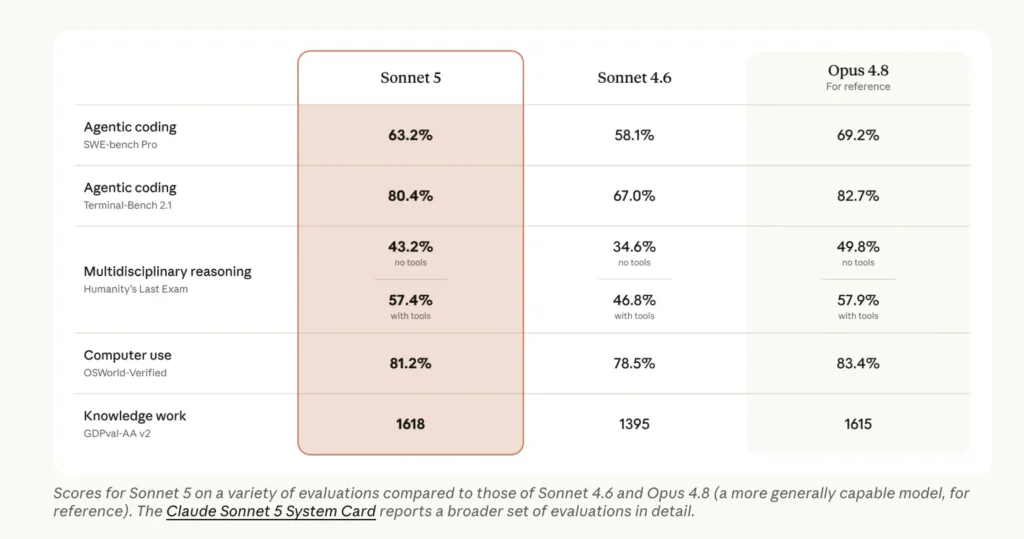
anthropic claude sonnet 5 vs sonnet 4.6 vs opus 4.8: agentic coding benchmarks, api pricing, and cost performance tradeoffs compared

Anthropic Claude Sonnet 5 vs Sonnet 4.6 vs Opus 4.8: Agentic Coding Benchmarks, API Pricing, and Cost-Performance Tradeoffs Compared

Anthropic just shipped Claude Sonnet 5. They call it its most agentic Sonnet model yet. It plans, drives browsers and terminals, and runs autonomously across long tasks. Sonnet 5 is the default model for Free and Pro plans today. Max, Team, and Enterprise users can select it. It is also live in Claude Code and

Anthropic Claude Sonnet 5 vs Sonnet 4.6 vs Opus 4.8: Agentic Coding Benchmarks, API Pricing, and Cost-Performance Tradeoffs Compared Read More »