
Tech

how america's 250th birthday became a test of ai powered collective intelligence

How America’s 250th birthday became a test of AI-powered collective intelligence

Imagine if you could bring 250 people together in a massive room and have them discuss and debate an important issue, arguing the points and counterpoints, and converging on answers that accurately reflect their collective knowledge, wisdom, values, and sensibilities. Now imagine that you convened this debate on America’s 250th birthday and asked 250 randomly […]

How America’s 250th birthday became a test of AI-powered collective intelligence Read More »
Anthropic Launches Claude Science Beta: A Multi-Agent AI Workbench for Reproducible Genomics, Proteomics, and Cheminformatics Pipelines

This week, Anthropic released Claude Science. It is an app for scientists, available in beta. It runs on Anthropic’s existing Claude models, not a new model. The app targets researchers who juggle databases, notebooks, and cluster terminals. It runs multi-step research and records how each result was made. The beta is available for Pro, Max,

Anthropic Launches Claude Science Beta: A Multi-Agent AI Workbench for Reproducible Genomics, Proteomics, and Cheminformatics Pipelines Read More »

nvidia horizon: a hands free agent that evolves git worktrees and hits 100% rtl benchmark completion

NVIDIA HORIZON: A Hands-Free Agent that Evolves Git Worktrees and Hits 100% RTL Benchmark Completion

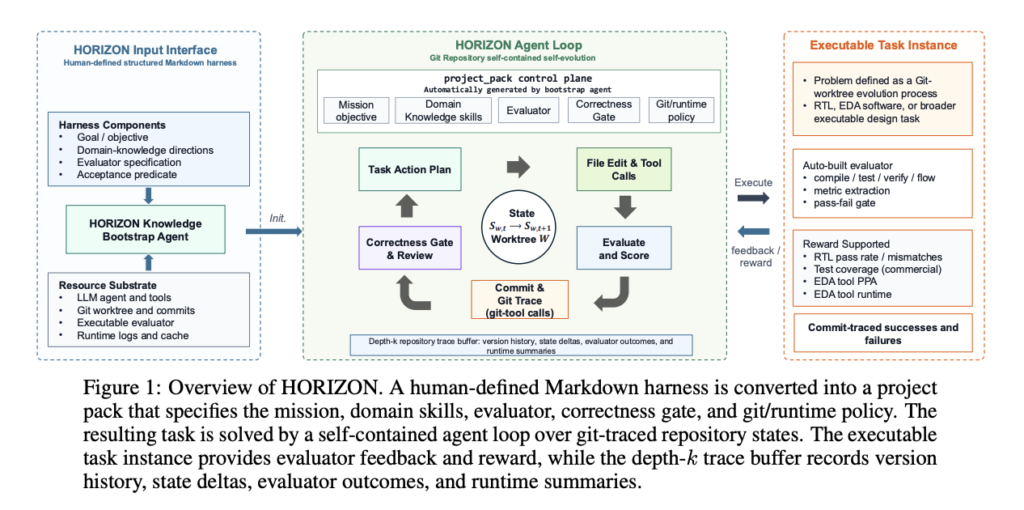
NVIDIA Research introduced HORIZON, a hands-free agent framework for hardware design. It treats hardware design as repository-level code evolution. This research team exercises the register-transfer level (RTL) instantiation. A structured Markdown harness becomes a project pack. A self-contained agent loop then evolves an isolated git worktree. It commits a version only when an executable acceptance

NVIDIA HORIZON: A Hands-Free Agent that Evolves Git Worktrees and Hits 100% RTL Benchmark Completion Read More »

NVIDIA AI Introduces ASPIRE: A Self-Improving Robotics Framework Reaching 31% Zero-Shot on LIBERO-Pro Long Tasks

Traditional robot programming is hard to scale. It requires orchestrating multimodal perception, physical contact dynamics, diverse configurations, and execution failures by hand. Code-as-policy systems let language models compose these into executable robot programs. That makes robot behavior inspectable, editable, and debuggable. But existing robotic coding agents run in naive execution environments. They receive only coarse,

NVIDIA AI Introduces ASPIRE: A Self-Improving Robotics Framework Reaching 31% Zero-Shot on LIBERO-Pro Long Tasks Read More »

Mistral AI Releases Leanstral 1.5: An Apache-2.0 Lean 4 Code Agent Model Solving 587 of 672 PutnamBench Problems

Today, Mistral AI released Leanstral 1.5. It is a code agent model built for Lean 4. The release targets automated theorem proving and proof engineering. Weights are open under Apache 2.0. A free API endpoint, leanstral-1-5, is now live. Leanstral 1.5 updates the earlier Leanstral-2603 model. It belongs to the Mistral Small 4 family. What

Mistral AI Releases Leanstral 1.5: An Apache-2.0 Lean 4 Code Agent Model Solving 587 of 672 PutnamBench Problems Read More »

Designing a Schema-Guided Invoice Intelligence Pipeline with lift-pdf for Accounts-Payable Extraction, Validation, and Ledger Generation

In this tutorial, we build an end-to-end accounts-payable extraction pipeline with lift-pdf, using synthetic invoice PDFs as controlled test documents and a structured JSON schema as the target output format. Instead of treating invoice parsing as a simple OCR task, we frame it as schema-guided document understanding: we generate realistic invoices, define fields such as

Designing a Schema-Guided Invoice Intelligence Pipeline with lift-pdf for Accounts-Payable Extraction, Validation, and Ledger Generation Read More »

trunk tools' stack cut document review from 60 days to 10 by ditching general purpose models

Trunk Tools’ stack cut document review from 60 days to 10 by ditching general-purpose models

Most verticals aren’t clean, well-oiled SaaS databases; the reality is ugly documents, proprietary schemas, implicit workflows, and long‑running tasks that most general-purpose models struggle with. This prompted construction project management company Trunk Tools to build a specialized, three-layer architecture — perception, semantics, agents — based on highly-detailed data to support high-accuracy, highly-relevant industry automation. Their

Trunk Tools’ stack cut document review from 60 days to 10 by ditching general-purpose models Read More »

Meet WebBrain: An Open-Source, Local-First AI Browser Agent That Reads Pages and Automates Tasks in Chrome and Firefox

WebBrain is a free, open-source browser agent for Chrome and Firefox. It reads pages, extracts data, and automates multi-step tasks. Unlike most browser AI plugins, it can also run entirely on a local model. It is built by Emre Sokullu and licensed under MIT. The full source lives on GitHub.  Run the agent against a

Meet WebBrain: An Open-Source, Local-First AI Browser Agent That Reads Pages and Automates Tasks in Chrome and Firefox Read More »

Interfaze Ships diffusion-gemma-asr-small, an Open-Source Diffusion ASR Model Transcribing Six Languages via DiffusionGemma’s Parallel Denoising Decoder

Interfaze, a young YC’s startup, has open-sourced a new speech recognition model. It is called diffusion-gemma-asr-small. The model transcribes audio through a diffusion decoder, not an autoregressive one. It is described as the first multilingual audio diffusion ASR model. One adapter handles six languages. The research team trained only about 42M parameters on top of

Interfaze Ships diffusion-gemma-asr-small, an Open-Source Diffusion ASR Model Transcribing Six Languages via DiffusionGemma’s Parallel Denoising Decoder Read More »

RAG-Anything Tutorial: Build a Multimodal Retrieval Pipeline for Text, Tables, Equations, and Images in Colab

In this tutorial, we build a RAG-Anything workflow and use it to explore how multimodal retrieval works across text, tables, equations, and images. We start by preparing the Colab environment, installing the required packages, and securely entering our OpenAI API key at runtime to keep the notebook practical and safe to run. We then create

RAG-Anything Tutorial: Build a Multimodal Retrieval Pipeline for Text, Tables, Equations, and Images in Colab Read More »