Mira Murati’s Thinking Machines Lab Makes The Technical Case For Human-Centered AI Built On Customizable Model Weights

Thinking Machines Lab published a report to build AI that extends human will and judgment. Most AI in use today is trained in a handful of places, then frozen. The report argues that this design excludes the people a model serves. Instead, the Thinking Machines lab researchers want AI that is distributed, customizable, and shaped […]

Mira Murati’s Thinking Machines Lab Makes The Technical Case For Human-Centered AI Built On Customizable Model Weights Read More »

A Coding Guide to NVIDIA’s Tile-Based GPU Programming: From cuTile and Triton Kernels to Flash Attention

In this tutorial, we explore TileGym GPU programming by building a practical Colab workflow that runs across different hardware conditions. We begin by probing the available CUDA environment, checking whether NVIDIA cuTile runs directly, and falling back to Triton when standard Colab GPUs lack the required cuTile stack. Through this setup, we learn the core

A Coding Guide to NVIDIA’s Tile-Based GPU Programming: From cuTile and Triton Kernels to Flash Attention Read More »

forget typosquatting; slopsquatting is the software supply chain threat created by ai coding tools

Forget typosquatting; slopsquatting is the software supply chain threat created by AI coding tools

Slopsquatting represents an emerging supply chain threat made possible by AI hallucinations. As developers increasingly rely on AI coding assistants, they unknowingly grant cybercriminals access to their software from day one.  Understanding what slopsquatting is Slopsquatting is a new type of supply chain attack that uses large language model (LLM) hallucinations to inject malicious code

Forget typosquatting; slopsquatting is the software supply chain threat created by AI coding tools Read More »

ant group’s robbyant unveils lingbot va 2.0: a causal video action model built natively for physical ai

Ant Group’s Robbyant Unveils LingBot-VA 2.0: A Causal Video-Action Model Built Natively for Physical AI

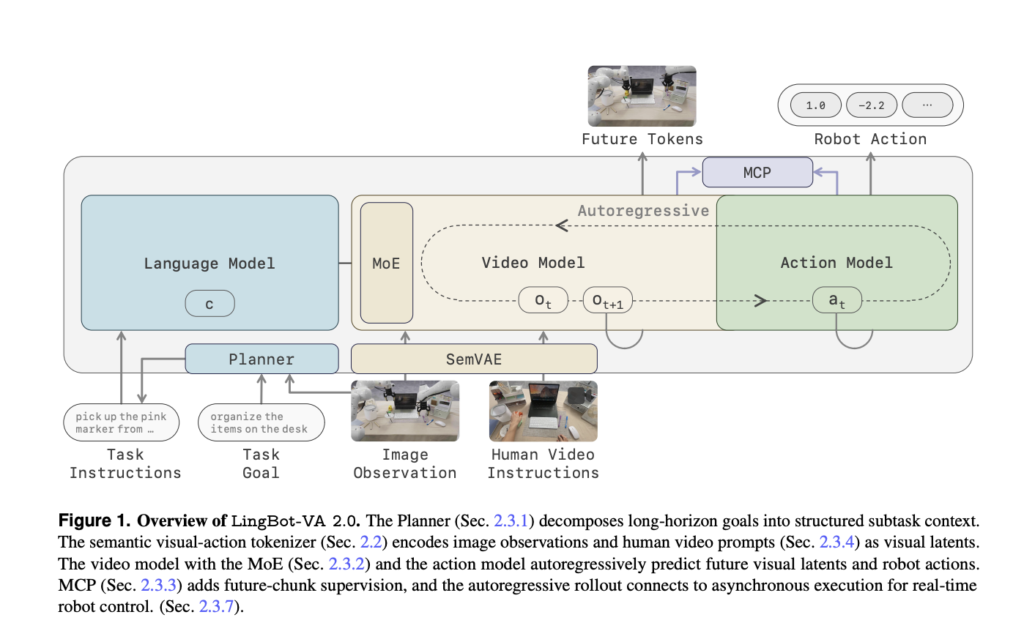
Robbyant, the embodied AI unit inside Ant Group, has released the LingBot-VA 2.0.The first embodied-native foundation model. It describes a video-action foundation model for generalist robot manipulation. The research team pretrains the whole stack for embodiment instead of fine-tuning a video generator. What is LingBot-VA 2.0? Most video-action models reuse two components built for digital

Ant Group’s Robbyant Unveils LingBot-VA 2.0: A Causal Video-Action Model Built Natively for Physical AI Read More »

57% of enterprises have watched ai agents be confidently wrong. the fix is an agentic context layer, but who has one?

57% of enterprises have watched AI agents be confidently wrong. The fix is an agentic context layer, but who has one?

An enterprise AI agent answers with total confidence, but the number is wrong. Nobody catches it until someone traces it back to a stale metric definition or a document the retrieval system never pulled. The model did not fail. The context it was given did. In the past six months, 57% of enterprises traced a

57% of enterprises have watched AI agents be confidently wrong. The fix is an agentic context layer, but who has one? Read More »

Kyutai Releases MuScriptor: An Open-Weight Decoder-Only Transformer for Multi-Instrument Music Transcription to MIDI

Automatic Music Transcription (AMT) converts an audio recording into symbolic notes, usually MIDI. Single-instrument transcription already works reasonably well. However, transcribing a full multi-instrument mix stays difficult. Kyutai and Mirelo team now release MuScriptor to close that gap. It is an open-weight model trained on real, multi-instrument recordings across many genres. This article explains how

Kyutai Releases MuScriptor: An Open-Weight Decoder-Only Transformer for Multi-Instrument Music Transcription to MIDI Read More »

openai introduces chatgpt work, a cloud based ai agent that manages tasks across email, slack and calendars

OpenAI introduces ChatGPT Work, a cloud-based AI agent that manages tasks across email, Slack and calendars

OpenAI on Thursday launched ChatGPT Work, a new AI agent embedded inside its flagship chatbot that aims to transform ChatGPT from a question-and-answer tool into an autonomous work platform capable of executing complex, multi-step tasks across users’ email, calendars, code repositories, and messaging apps. The product is powered by OpenAI’s latest flagship model, GPT-5.6, and

OpenAI introduces ChatGPT Work, a cloud-based AI agent that manages tasks across email, Slack and calendars Read More »

wall street is debating the ai buildout. enterprises just answered: 86% say their gpus run at half capacity or less

Wall Street is debating the AI buildout. Enterprises just answered: 86% say their GPUs run at half capacity or less

Enterprise companies are running AI agents ahead of the controls needed to manage them — and they deployed that way knowingly. That is the central finding from VentureBeat Research’s June survey of 573 technical leaders at companies with 100 or more employees, fielded across five parallel surveys of the agentic stack.  Enterprises are now retrofitting

Wall Street is debating the AI buildout. Enterprises just answered: 86% say their GPUs run at half capacity or less Read More »

Meet LingBot-World-Infinity: An Open Causal World Model With An Agentic Harness

Robbyant, Ant Group’s embodied-intelligence unit, has released LingBot-World-Infinity (LingBot-World 2.0). It is a causal video generation model that behaves as an interactive world simulator. It is how the team attacks two failure modes: long-horizon drift and interactive latency. What is LingBot-World-Infinity? An interactive world model generates video frame by frame, conditioned on a stream of

Meet LingBot-World-Infinity: An Open Causal World Model With An Agentic Harness Read More »

Meta Superintelligence Labs Releases Muse Spark 1.1: A Multimodal Reasoning Model for Agentic Tasks on Meta Model API

Today, Meta Superintelligence Labs released Muse Spark 1.1. Alongside it, Meta opened a public preview of the Meta Model API. That second part is the structural change. Meta’s models previously reached developers mainly as open weights. Muse Spark 1.1 is closed, hosted, and metered per token. So the question is narrow. Where does it belong

Meta Superintelligence Labs Releases Muse Spark 1.1: A Multimodal Reasoning Model for Agentic Tasks on Meta Model API Read More »