Ai

Google AI Studio Adds Import from GitHub to Build a Deployable App

Google AI Studio is rolling out an ‘import from GitHub’ feature inside its Build mode. It takes a repo and transforms it into a runtime-compatible format. You can then keep iterating on it, deploy it, and more. The update was shared by the Google AI Studio account and by Logan Kilpatrick, who leads the product. […]

Google AI Studio Adds Import from GitHub to Build a Deployable App Read More »

Datalab Lift vs the Field: How a 9B Schema-First Extractor Compares with NuExtract3, LlamaExtract, Marker, and Docling

Datalab’s Lift is a focused document extraction tool with a specific promise: give it a PDF or image plus a JSON Schema, and it returns schema-shaped JSON directly. Instead of converting a document to Markdown first and then asking another model to extract fields, Lift reads rendered page images and attempts to emit the final

Datalab Lift vs the Field: How a 9B Schema-First Extractor Compares with NuExtract3, LlamaExtract, Marker, and Docling Read More »

Robbyant Releases LingBot-VLA 2.0: An Open-Source 6B Vision-Language-Action (VLA) Model for Cross-Embodiment Robot Manipulation

Ant Group’s Robbyant has released LingBot-VLA 2.0, a Vision-Language-Action (VLA) foundation model for robots. The release includes a technical report, an Apache-2.0 codebase, and a 6B checkpoint. The research team targets a well-known gap: VLA models often work in labs but stumble in deployment. LingBot-VLA 2.0 advances the prior version along three practical axes. These

Robbyant Releases LingBot-VLA 2.0: An Open-Source 6B Vision-Language-Action (VLA) Model for Cross-Embodiment Robot Manipulation Read More »

SpaceXAI Releases Grok 4.5, a Cursor-Trained Model for Coding, Agentic Tasks, and Knowledge Work at $2/M Input

SpaceXAI just released Grok 4.5. The company calls it its smartest model to date. It targets coding, agentic tasks, and knowledge work. SpaceXAI says Grok 4.5 was trained alongside Cursor, an AI coding editor. TL;DR Grok 4.5 targets coding, agentic tasks, and knowledge work, trained alongside Cursor. In SpaceXAI’s own chart, Fable (max) leads all

SpaceXAI Releases Grok 4.5, a Cursor-Trained Model for Coding, Agentic Tasks, and Knowledge Work at $2/M Input Read More »

spacex's grok 4.5 launches at half the price of rivals — here's why that could rattle anthropic and openai

SpaceX’s Grok 4.5 launches at half the price of rivals — here’s why that could rattle Anthropic and OpenAI

Elon Musk’s SpaceX released Grok 4.5 on Wednesday, the first artificial intelligence model the company has trained specifically for coding and autonomous agents — and the first tangible product of its $60 billion acquisition of the AI coding startup Cursor, completed just weeks ago. The launch marks a pivotal test of the sprawling, vertically integrated

SpaceX’s Grok 4.5 launches at half the price of rivals — here’s why that could rattle Anthropic and OpenAI Read More »

NVIDIA’s Cosmos-Framework Tutorial: Designing a Colab-Friendly Miniature of Cosmos 3 World Models with Omnimodal Mixture-of-Transformers

In this tutorial, we explore NVIDIA’s cosmos-framework from a practical Colab-friendly angle while staying honest about the hardware limits of running real Cosmos 3 checkpoints. We begin by checking the current runtime, GPU capabilities, CUDA availability, memory, and disk space to understand why full Cosmos 3 inference is not realistic on standard Colab hardware. Instead

NVIDIA’s Cosmos-Framework Tutorial: Designing a Colab-Friendly Miniature of Cosmos 3 World Models with Omnimodal Mixture-of-Transformers Read More »

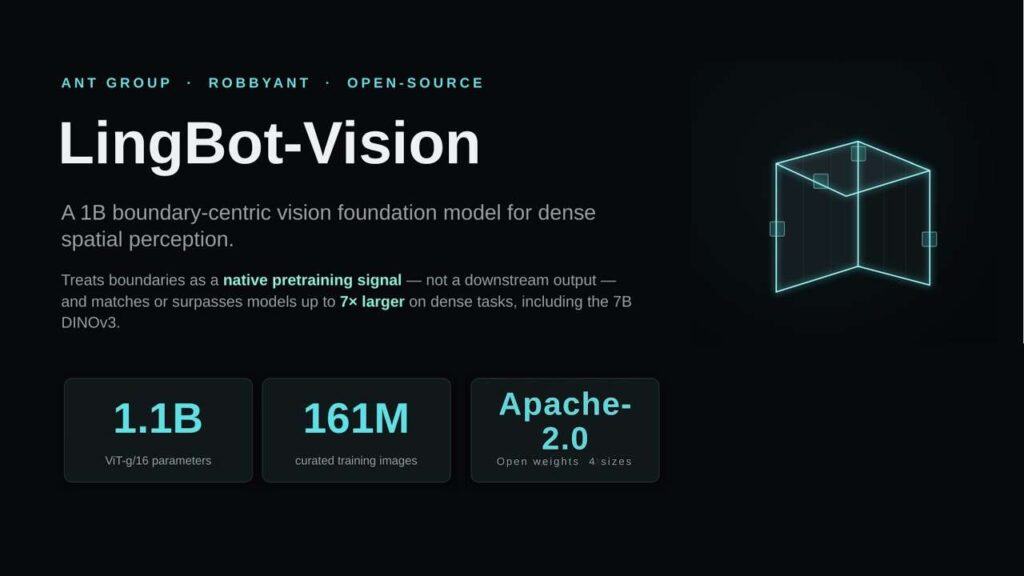
ant group’s robbyant open sources lingbot vision: a 1b boundary centric vision foundation model for dense spatial perception

Ant Group’s Robbyant Open-Sources LingBot-Vision: A 1B Boundary-Centric Vision Foundation Model for Dense Spatial Perception

Robbyant, the embodied-AI company within Ant Group, has open-sourced LingBot-Vision, a family of self-supervised Vision Transformers built for dense spatial perception. The weights ship under Apache-2.0 on Hugging Face in four sizes — ViT-giant, ViT-large, ViT-base, and ViT-small — together with a technical report and inference code. Most vision foundation models are trained for semantic

Ant Group’s Robbyant Open-Sources LingBot-Vision: A 1B Boundary-Centric Vision Foundation Model for Dense Spatial Perception Read More »

NVIDIA Releases Audex (Nemotron-Labs-Audex-30B-A3B): A Unified Audio-Text LLM That Preserves the Text Intelligence of Its Backbone

NVIDIA has released Audex (Nemotron-Labs-Audex-30B-A3B), a unified audio-text large language model. It understands and generates both audio and speech. It also keeps the text intelligence of its backbone. The checkpoints, along with a smaller Audex-2B, are released under a noncommercial license. Most multimodal models pay a text tax. When labs add audio or vision output,

NVIDIA Releases Audex (Nemotron-Labs-Audex-30B-A3B): A Unified Audio-Text LLM That Preserves the Text Intelligence of Its Backbone Read More »

the real cost, security, and culture problems behind enterprise ai agents

The real cost, security, and culture problems behind enterprise AI agents

Presented by Red Hat At VentureBeat’s recent AI Impact event, where the discussion centered on what separates enterprises that scale agentic AI from those that stall in pilot mode, Brian Gracely, senior director of portfolio strategy at Red Hat, detailed what companies actually run into once agents reach production. He dove into cost discipline, the

The real cost, security, and culture problems behind enterprise AI agents Read More »

Liquid AI Open-Sources Antidoom: A Final Token Preference Optimization (FTPO) Method that Reduces Doom Loops in Reasoning Models

Liquid AI has released Antidoom, an open-source method that targets a common failure mode in reasoning models. That failure mode is the doom loop. In a doom loop, a model emits a span. It then repeats that span again and again. The output continues until the context window is exhausted. Small reasoning models are more

Liquid AI Open-Sources Antidoom: A Final Token Preference Optimization (FTPO) Method that Reduces Doom Loops in Reasoning Models Read More »