Ai

openai's updated gpt 5.5 instant is better at shopping, complex constraints, and understanding user intent  — and it's already in the api

OpenAI’s updated GPT-5.5 Instant is better at shopping, complex constraints, and understanding user intent  — and it’s already in the API

OpenAI has made a significant update to its most widely used language model, GPT-5.5 Instant, which is the default in the free version of ChatGPT. The company announced the upgraded version of GPT-5.5 Instant yesterday on X, calling it “much more fun to talk to” and saying it is “better at understanding the intent behind […]


OpenAI’s updated GPT-5.5 Instant is better at shopping, complex constraints, and understanding user intent  — and it’s already in the API Read More »

alibaba's model never trained as an agent — and improved agent performance across seven benchmarks

Alibaba’s model never trained as an agent — and improved agent performance across seven benchmarks

Alibaba’s Qwen team released Qwen-AgentWorld on Tuesday — two models trained not to act inside agent environments, but to predict what those environments return. The release covers seven domains under a single architecture: MCP, Search, Terminal, Software Engineering, Android, Web, and OS. The release extends Alibaba’s recent push into autonomous agents. Qwen3.7-Max, released in May,

Alibaba’s model never trained as an agent — and improved agent performance across seven benchmarks Read More »

anthropic launches claude tag, replacing its slack app with a persistent ai teammate that learns, monitors and works autonomously

Anthropic launches Claude Tag, replacing its Slack app with a persistent AI teammate that learns, monitors and works autonomously

Anthropic on Tuesday launched Claude Tag, a new product that embeds its most advanced AI model directly inside Slack as a persistent, shared teammate that anyone on a team can delegate work to by simply typing @Claude. The product, available today in beta for Claude Enterprise and Team customers, replaces Anthropic’s existing Claude in Slack

Anthropic launches Claude Tag, replacing its Slack app with a persistent AI teammate that learns, monitors and works autonomously Read More »

alibaba's ai video model rises to no. 2 in global rankings, as openai's sora and bytedance's seedance fall away

Alibaba’s AI video model rises to No. 2 in global rankings, as OpenAI’s Sora and ByteDance’s Seedance fall away

Alibaba Cloud on Sunday released HappyHorse 1.1, a major upgrade to its AI video generation model that the company says delivers production-ready video synthesis across core content creation scenarios. The model is now live on Alibaba Cloud Model Studio with full API access for enterprise customers and developers, accompanied by a 40% sitewide launch discount

Alibaba’s AI video model rises to No. 2 in global rankings, as OpenAI’s Sora and ByteDance’s Seedance fall away Read More »

How to Build a Forecasting Pipeline with TimeCopilot Using Foundation Models and Automated Anomaly Detection

In this tutorial, we build an end-to-end forecasting workflow with TimeCopilot. We prepare a panel dataset containing real airline passenger data and a synthetic seasonal series with injected anomalies, then evaluate a diverse collection of statistical, foundation, and optional GPU-based forecasting models. We use rolling cross-validation and multiple error metrics to identify the strongest model,

How to Build a Forecasting Pipeline with TimeCopilot Using Foundation Models and Automated Anomaly Detection Read More »

Cisco AI Introduces FAPO: Pipeline-Aware Prompt Optimization With Step-Level Failure Attribution and Claude Code Orchestration

Getting prompts right is still the hardest part of shipping reliable LLM applications. Small wording changes can swing accuracy by 20 percent. What works on a few examples often breaks at scale. When a multi-step pipeline returns a wrong answer, finding the failing step means inspecting intermediate outputs by hand. Cisco AI introduced FAPO to

Cisco AI Introduces FAPO: Pipeline-Aware Prompt Optimization With Step-Level Failure Attribution and Claude Code Orchestration Read More »

Nous Research Updates Hermes Agent With a Blank Slate Mode That Pins Toolsets via platform_toolsets.cli and disabled_toolsets

Nous Research has added a Blank Slate setup mode to its open-source Hermes Agent. It inverts the usual onboarding. Instead of a fully loaded default, you start with almost nothing. Hermes Agent is the self-improving agent framework from Nous Research. It runs on your own machine. The team announced the new mode on X. Blank

Nous Research Updates Hermes Agent With a Blank Slate Mode That Pins Toolsets via platform_toolsets.cli and disabled_toolsets Read More »

Yandex Open-Sources YaFF: A Zero-Copy Wire Format for Protobuf With Near-Struct Read Speed

TLDR YaFF is Yandex’s open-source zero-copy wire format for Protobuf — Apache 2.0, currently C++, v0.1.0. The .proto file stays the source of truth; only the physical memory layout changes. On Yandex’s benchmarks, the Flat Layout reads hot data ~3.8× faster than FlatBuffers, within 1.2× of a raw C++ struct. Four layouts — Fixed, Flat,

Yandex Open-Sources YaFF: A Zero-Copy Wire Format for Protobuf With Near-Struct Read Speed Read More »

How to Build a Forecasting Pipeline with TimeCopilot Using Foundation Models and Automated Anomaly Detection

In this tutorial, we build an end-to-end forecasting workflow with TimeCopilot. We prepare a panel dataset containing real airline passenger data and a synthetic seasonal series with injected anomalies, then evaluate a diverse collection of statistical, foundation, and optional GPU-based forecasting models. We use rolling cross-validation and multiple error metrics to identify the strongest model,

How to Build a Forecasting Pipeline with TimeCopilot Using Foundation Models and Automated Anomaly Detection Read More »

Screenshot 2026 06 19 At 3.49.19 PM 1 ECOLne 1024x572

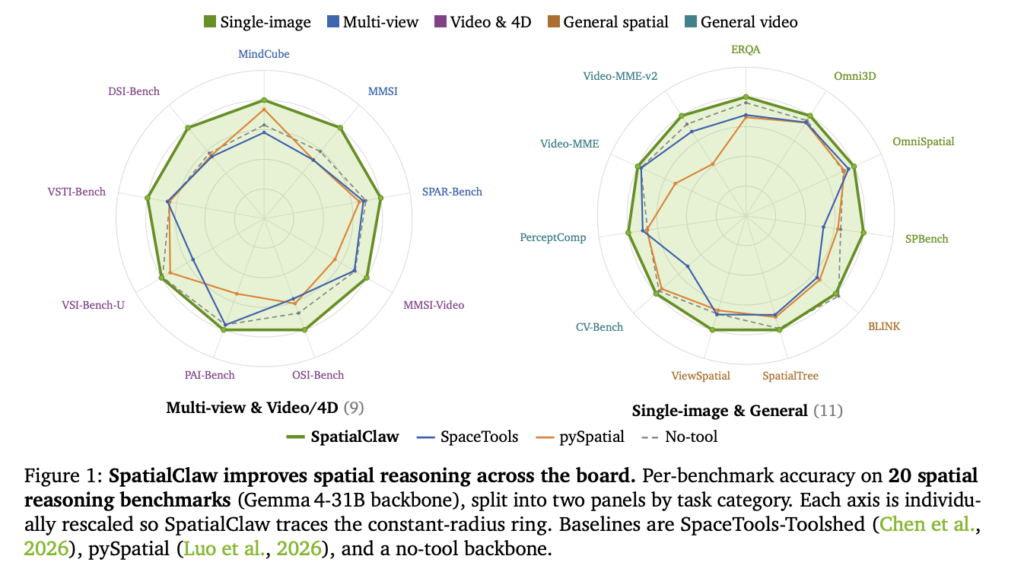
NVIDIA AI Introduce SpatialClaw: A Training-Free Agent That Treats Code as the Action Interface for Spatial Reasoning

NVIDIA Research has released SpatialClaw, a training-free framework for spatial reasoning. It targets a persistent weakness in vision-language models (VLMs). These models still struggle to judge where objects are, how they relate, and how they move in 3D. SpatialClaw does not retrain the model. Instead, it changes the action interface the agent uses to call

NVIDIA AI Introduce SpatialClaw: A Training-Free Agent That Treats Code as the Action Interface for Spatial Reasoning Read More »