Ai

Google Releases Gemini 3.5 Live Translate, a Streaming Speech-to-Speech Audio Model Covering 70+ Languages Across Meet, Translate, and the Live API

Google just announced Gemini 3.5 Live Translate. It is their latest audio model for live speech-to-speech translation. Speech-to-speech means spoken audio goes in, and translated spoken audio comes out. The model detects over 70 languages automatically and generates translated speech. It preserves the speaker’s intonation, pacing, and pitch in the output. Turn-by-turn systems wait for […]


Google Releases Gemini 3.5 Live Translate, a Streaming Speech-to-Speech Audio Model Covering 70+ Languages Across Meet, Translate, and the Live API Read More »

ChatGPT Image Jun 9 2026 01 10 24 PM ZCBokt

Anthropic brings Mythos to the masses with Claude Fable 5, its most powerful generally available model ever

Anthropic today launched two new AI models — Claude Fable 5 and Claude Mythos 5 — marking the company’s first broad release of the powerful “Mythos-class” AI capabilities it previously made available only to participating organizations in its restricted cybersecurity program, Project Glasswing, which it announced two months ago. The company says Fable 5, which

Anthropic brings Mythos to the masses with Claude Fable 5, its most powerful generally available model ever Read More »

ChatGPT Image Jun 8 2026 05 47 27 PM 7zX0lO

Researchers trained an open source AI search agent, Harness-1, that outperforms GPT-5.4 on recalling relevant information

A joint research collaboration between researchers at the University of Illinois at Urbana-Champaign (UIUC), UC Berkeley, and the open source AI-native vector database platform Chroma unveiled Harness-1, a 20-billion parameter open-source search agent built atop OpenAI’s gpt-oss-20B open source model that fundamentally redesigns how AI executes complex retrieval tasks. Harness-1 achieves a massive leap in

Researchers trained an open source AI search agent, Harness-1, that outperforms GPT-5.4 on recalling relevant information Read More »

ClawHub Security Signals: A Coding Guide to End-to-End Security Signal Analysis and Verdict Classification on the AI Skills Dataset

In this tutorial, we use the ClawHub Security Signals dataset to examine how different security scanners assess AI skills and related files. We load the dataset directly from the Hugging Face Parquet conversion to avoid compatibility issues with newer dataset metadata, then inspect the main columns, verdict distribution, scanner outputs, and severity labels. After exploring

ClawHub Security Signals: A Coding Guide to End-to-End Security Signal Analysis and Verdict Classification on the AI Skills Dataset Read More »

Xiaomi MiMo and TileRT Push a 1-Trillion-Parameter Model Past 1000 Tokens Per Second on Commodity GPUs

Inference speed is becoming a competitive metric for large language models. Xiaomi’s MiMo team just released MiMo-V2.5-Pro-UltraSpeed, built in collaboration with the TileRT systems group. It decodes faster than 1000 tokens per second on a 1-trillion-parameter model. Xiaomi team describes this as a first at trillion-parameter scale. Demos show generation peaks near 1200 tokens per

Xiaomi MiMo and TileRT Push a 1-Trillion-Parameter Model Past 1000 Tokens Per Second on Commodity GPUs Read More »

Microsoft AI Introduces MAI-Transcribe-1.5: 2.4% WER on Artificial Analysis, Best-in-Class FLEURS Accuracy, and Up to 5x Faster Long-Audio Transcription

Last week Microsoft AI has announced MAI-Transcribe-1.5. It is the second iteration of the company’s in-house speech-to-text family. The model targets accuracy across 43 languages, accents, and noisy environments. The Microsoft team positions it for production transcription workloads. What is MAI-Transcribe-1.5 MAI-Transcribe-1.5 is an automatic speech recognition (ASR) model. It takes audio as input and

Microsoft AI Introduces MAI-Transcribe-1.5: 2.4% WER on Artificial Analysis, Best-in-Class FLEURS Accuracy, and Up to 5x Faster Long-Audio Transcription Read More »

Building Reflective Prompt Optimization with GEPA: Multi-Component Prompts, Structured Feedback, and Held-Out Validation

In this tutorial, we use GEPA as a reflective prompt-evolution framework to improve the way a language model solves arithmetic word problems. We begin with a weak seed prompt, create a small deterministic benchmark, define a structured evaluator, and pass actionable feedback to GEPA so it can understand why a candidate prompt fails. We also

Building Reflective Prompt Optimization with GEPA: Multi-Component Prompts, Structured Feedback, and Held-Out Validation Read More »

Engineering 1 DOy9cx

Agentic AI solved coding — and exposed every other problem in software engineering

Agentic AI is now a core part of the engineering process, driving massive execution leverage and helping us generate more code than ever before. Yet, a difficult question I’ve increasingly heard from business leaders is: if we’re shipping code faster than ever, why aren’t our products improving at the same rate? The reason is that

Agentic AI solved coding — and exposed every other problem in software engineering Read More »

Screenshot 2026 06 06 At 11.13.42 PM 1 Wh23iM 1024x523

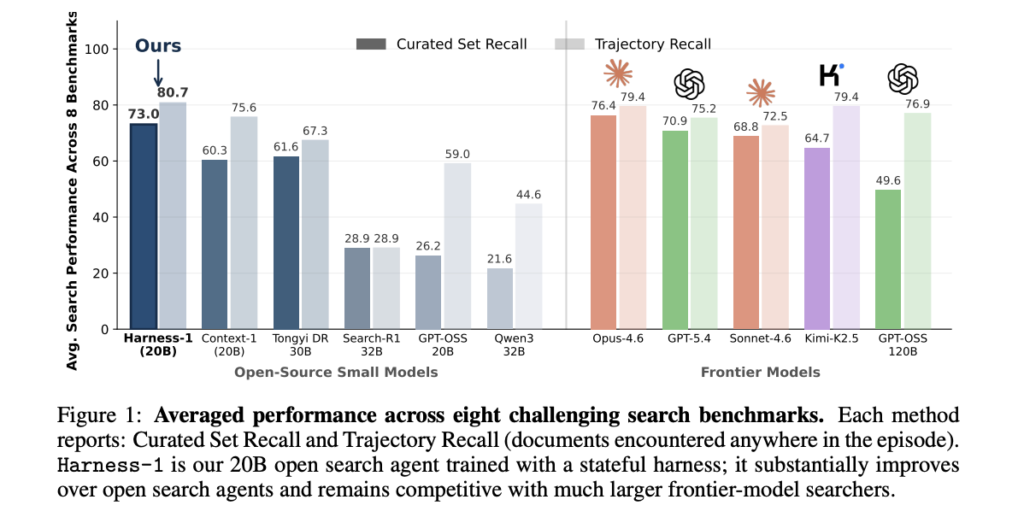
Meet Harness-1: A 20B Retrieval Subagent Trained With Reinforcement Learning Inside a Stateful Search Harness on gpt-oss-20b

Most search agents are trained as policies over a growing transcript. The model decides how to search. It must also remember what it saw, which evidence matters, and which claims it checked. A team of researchers from University of Illinois Urbana-Champaign, UC Berkeley, and Chroma argues this asks too much. Reinforcement learning ends up optimizing

Meet Harness-1: A 20B Retrieval Subagent Trained With Reinforcement Learning Inside a Stateful Search Harness on gpt-oss-20b Read More »